Biomedical Sciences Courses
Biomedical sciences courses can help you learn human anatomy, physiology, genetics, and microbiology. You can build skills in laboratory techniques, data analysis, and critical thinking necessary for research and clinical applications. Many courses introduce tools like PCR machines for DNA analysis, imaging software for visualizing biological structures, and statistical software for interpreting research data, all of which are essential in advancing healthcare solutions and understanding complex biological systems.
Popular Biomedical Sciences Courses and Certifications
 Status: Free Trial
University of Colorado Boulder
Skills you'll gain: Molecular Biology, Biochemistry, Human Development, Biology, Life Sciences, Environment, Molecular, Cellular, and Microbiology, Chemistry, Cell Biology, Child Development, Environmental Science, Environmental Resource Management, Music, Biotechnology, Environment and Resource Management, General Science and Research, Decision Making, Natural Resource Management, Liberal Arts, Oncology
 Status: Preview
University of Glasgow
Skills you'll gain: 3D Modeling, Biomedical Technology, Scientific Visualization, 3D Assets, Anatomy, Virtual Reality, Web Content Accessibility Guidelines, Medical Terminology, Data Visualization, Medical Imaging, Augmented and Virtual Reality (AR/VR), Software Visualization, Disabilities, Augmented Reality, Animations, Technical Communication, Computer Graphic Techniques, Visual Design, Virtual Environment, Simulations
 Status: Free Trial
Icahn School of Medicine at Mount Sinai
Skills you'll gain: Matlab, Bioinformatics, Mathematical Software, Quantitative Research, Electrophysiology, Unsupervised Learning, Data Synthesis, Research, Mathematical Modeling, Molecular Biology, Simulation and Simulation Software, Pharmacology, Science and Research, Cell Biology, Biotechnology, Laboratory Research, Molecular, Cellular, and Microbiology, General Science and Research, Network Analysis, Biology
 Status: Free Trial
University of Colorado Boulder
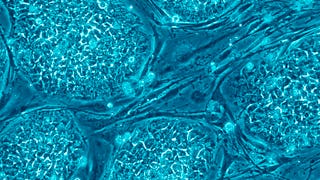
Skills you'll gain: Molecular Biology, Life Sciences, Biology, Molecular, Cellular, and Microbiology, Cell Biology, Biotechnology, Oncology, Environmental Issue, Biochemistry, Environment, Healthcare Ethics, Emerging Technologies, Ethical Standards And Conduct
 Status: Preview
American Museum of Natural History
Skills you'll gain: Medical Science and Research, Healthcare Ethics, Biomedical Technology, Clinical Research, Clinical Research Ethics, Biotechnology, Cell Biology, Life Sciences, Biology, Biological Engineering, Molecular, Cellular, and Microbiology, Precision Medicine, Molecular Biology, Laboratory Research
 Status: NewStatus: Free Trial
University of Colorado System
Skills you'll gain: Biostatistics, Bioinformatics, Statistical Machine Learning, Research Methodologies, Life Sciences, Science and Research, Human Development, Applied Machine Learning, Quantitative Research, Research Design, Clinical Research, Artificial Intelligence and Machine Learning (AI/ML), Social Determinants Of Health, Health Disparities, Biology, Molecular Biology, Cell Biology, Health Care, Health Equity, Health Policy
What brings you to Coursera today?
 Status: Preview
Stanford University
Skills you'll gain: Concision, Writing and Editing, Grammar, Writing, Peer Review, Editing, Journalism, Proofreading, Journals, Science and Research, Communication Strategies, Organizational Skills, Constructive Feedback, Planning
 Status: NewStatus: Free
The University of Tokyo
Skills you'll gain: Healthcare Ethics, Ethical Standards And Conduct, Patient Advocacy, Patient-centered Care, Informed Consent, Patient Communication, Public Health, Discussion Facilitation, Cultural Sensitivity, Social Justice, Cultural Diversity, Family Law
 Status: Preview
University of Manchester
Skills you'll gain: Biotechnology, Biological Engineering, Sustainable Technologies, Process Engineering, Molecular Biology, Chemical Engineering, Sustainable Engineering, Life Sciences, Biochemistry, Pharmaceuticals, Manufacturing and Production, Materials science, Medical Science and Research, Engineering Design Process, Drug Development, Scalability
 Status: Preview
Birla Institute of Technology & Science, Pilani
Skills you'll gain: Bioinformatics, Data Management, Clinical Data Management, Precision Medicine, Data Analysis, Data Mining, Applied Machine Learning, Unsupervised Learning, Cell Biology, Scientific Visualization, Large Language Modeling, LLM Application, Network Model, Data Preprocessing, Correlation Analysis, Chemical and Biomedical Engineering, Dimensionality Reduction, Computational Thinking, Markov Model, Algorithms
 Status: Free Trial
University of Colorado System
Skills you'll gain: Concision, Grant Writing, Writing, Grant Applications, Persuasive Communication, Communication, Organizational Skills, Analytical Skills
 Status: Preview
The State University of New York
Skills you'll gain: Bioinformatics, Big Data, Analytics, Health Informatics, R (Software), Advanced Analytics, Medical Science and Research, Predictive Analytics, R Programming, Predictive Modeling, Statistical Analysis, Data Cleansing, Molecular Biology, Feature Engineering, Data Preprocessing, Model Evaluation, Unsupervised Learning, Classification Algorithms
In summary, here are 10 of our most popular biomedical sciences courses
- Biology Everywhere: University of Colorado Boulder
- Biomedical Visualization: University of Glasgow
- Systems Biology and Biotechnology: Icahn School of Medicine at Mount Sinai
- The Little Stuff: Energy, Cells, and Genetics: University of Colorado Boulder
- The Science of Stem Cells: American Museum of Natural History
- Sex as a Biological Variable in the Conduct of Research: University of Colorado System
- Writing in the Sciences: Stanford University
- Biomedical Ethics and Public Health Ethics: The University of Tokyo
- Industrial Biotechnology: University of Manchester
- Introduction to Bioinformatics: Birla Institute of Technology & Science, Pilani










